Most toolbox talks are forgotten before the hard hat goes back on. They're rushed, generic, and read from a script no one wrote for the people actually listening. That’s not just a waste of time—it’s dangerous. A poorly written toolbox talk fails to connect, leaving real hazards unaddressed and workers underprepared.
Writing an effective toolbox talk isn’t about filling a template. It’s about crafting a targeted safety moment that sticks. This guide shows you how to write one that resonates, reduces risk, and earns attention—even on a Monday morning before the coffee kicks in.
Start with the Right Purpose—Not Just Compliance
Too many toolbox talks exist only to check a box. "Did the talk? Yes. Signed in? Yes." That mindset produces lazy content: recycled messages about “wearing your PPE” with no connection to the actual job at hand.
An effective toolbox talk starts with a clear, specific purpose: to prevent a real, imminent hazard present on today’s work site.
Ask: - What task is being done today or tomorrow? - What’s changed since the last talk? (Weather, crew, equipment, phase of work) - What near-misses or incidents happened recently—here or elsewhere?
Example: Instead of “General PPE Safety,” try “Safe Glove Use During Chemical Handling on Phase 2 Piping.” That’s specific, timely, and relevant.
Common Mistake: Using the same talk for every crew. A roofing team needs different warnings than an electrical installation team—even on the same site.
Know Your Audience Before You Write a Word
You wouldn’t write a sales pitch without knowing the buyer. Same here.
Who are you talking to? - Skill level (apprentice vs. veteran) - Language proficiency - Shift fatigue (2 PM vs. 6 AM crews hear things differently) - Prior knowledge of the hazard
A talk about arc flash risks written for electricians can use technical terms like “incident energy” and “18-calorie boundary.” But for laborers working nearby, it should focus on: “Stay behind the line. If you see electrical work, don’t walk through.”
Pro Tip: Run a one-sentence draft by a crew member. If they don’t get it immediately, rewrite it.
Structure It for Attention and Retention
Respect the clock. Most toolbox talks last 5–10 minutes. That means your writing must be sharp, visual, and conversational.
Use this structure:
1. Hook (30 seconds) Start with a question or story. > “Last week in Queensland, a worker lost two fingers because a grinder guard wasn’t secured. That could’ve been us.”
2. Hazard Focus (2 minutes) Define the hazard clearly. > “Today, we’re working with angle grinders on rebar. The risk? Uncontrolled rotation if the disc binds.”
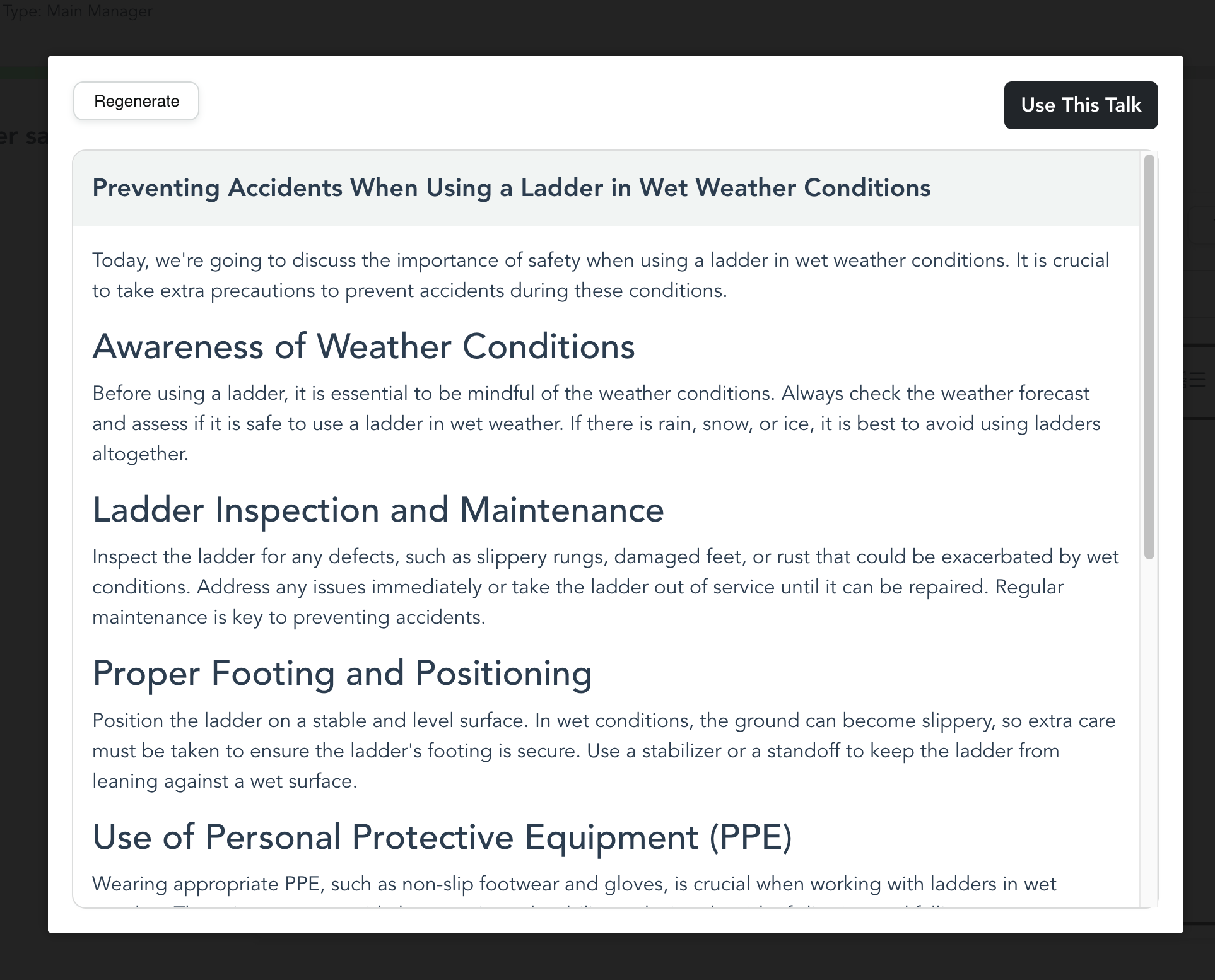
3. Control Measures (3 minutes) List actionable steps. > - Inspect the guard and side handle before use > - Hold the grinder with both hands > - Let it reach full speed before touching metal > - Never apply sideways pressure
4. Discussion Prompt (1–2 minutes) Ask for input. > “Has anyone here seen a grinder kick back? What did you do?”
5. Close with a Safety Commitment
“So today, everyone checks their grinder—guard, handle, disc. Confirm it with your partner. Let’s get through this shift with no incidents.”
This isn’t a lecture. It’s a conversation starter—written to provoke engagement.
Write in Plain, Active Language
Avoid corporate jargon like “utilize” or “ensure compliance.” Use words people actually speak.
Weak: "Personnel must ensure proper utilization of fall protection systems."
Strong: "If you’re working above 1.8 meters, your harness must be clipped in—no exceptions."
Use short sentences. Bullet points. Bold key warnings.
And never, ever copy-paste from a generic safety manual. Workers spot that instantly.
Realistic Use Case: On a concrete pour, instead of: > “Slip, trip, and fall hazards are prevalent.”
Say: > “Wet concrete is slick. Hoses on the ground? Trip wires. Keep your path clear. Watch your step when walking backward.”
Specificity builds credibility.
Include Real Examples and Near-Misses Abstract warnings don’t stick. Real stories do.
If there’s a recent incident—on your site or a similar one—use it (without naming names).
“Two weeks ago, a worker in Perth tripped over a trailing power cord. Broke his wrist. The cord wasn’t taped down. Today, we’re running temporary lighting. Let’s tape every cord or use overhead runs. No shortcuts.”
- This does two things:
- Proves the hazard is real
- Shows you’re paying attention
Even if no incident occurred, use a “what if” scenario: > “What if the wind picks up to 35 km/h while we’re lifting that sheet metal? Could it turn into a sail? Absolutely. So we wait for the all-clear from the spotter.”
Stories create mental rehearsal.
Keep It Visual and Practical
A toolbox talk isn’t a novel. It’s a field tool.
When writing, think about how it will be delivered.
Include: - A photo or diagram (e.g., correct vs. incorrect harness fit) - A quick demo cue (“Show me your hand signals for crane lift”) - A checklist (see below)
You’re not writing a memo—you’re scripting a safety intervention.
Checklist: What to Include in Your Draft - [ ] Specific task or activity named - [ ] Real hazard tied to today’s work - [ ] 3–5 clear control actions - [ ] One discussion question - [ ] Reference to a real event or near-miss - [ ] Plain language—no jargon - [ ] Delivery time under 10 minutes

Print it on a half-sheet. Use large font. Laminated copies survive rain and coffee spills.
Avoid These Five Writing Traps
Even well-intentioned talks fail when they fall into these traps:
- Too Broad
- “General Safety Reminder” tells workers nothing. No one acts on vague advice.
- Too Long
- More than one page? It won’t be read. Stick to the essentials.
- No Ownership
- Don’t say “they should.” Say “we do” or “you must.” Builds shared responsibility.
- No Follow-Up
- Writing the talk is half the job. The other half? Watching for changes in behavior.
- Zero Feedback Loop
- If workers never comment or suggest improvements, they’re not engaged. Build in space for their voice.
Test and Refine Your Talks The best toolbox talks evolve. After delivery, ask: - Did people look up from their gloves? - Did anyone ask a question? - Did anyone share a tip?
If the answer is no, rewrite it.
Track effectiveness over time: - Are there fewer near-misses related to that hazard? - Do crews reference the talk later? (“Remember what we said about ladder angles?”)
One superintendent in Alberta started ending talks with: “One thing you’ll do differently today?” He’d jot answers on a clipboard. Within a month, crew involvement jumped 70%.
Writing matters. But delivery and follow-through seal the deal.
Final Step: Make It a Habit, Not a Chore
Great toolbox talks don’t come from templates. They come from attention.
- Write it the night before, based on tomorrow’s plan
- Walk the site and see the hazard yourself
- Draft it in your own voice—like you’re talking to your team
- Keep a log of topics to avoid repetition
This isn’t paperwork. It’s leadership.
The best safety writers aren’t HR. They’re foremen, supervisors, and crew leads who care enough to write something worth hearing.
FAQ
What should a toolbox talk include? A clear hazard, specific control measures, real-world context, and a discussion prompt—all in under 10 minutes.
How long should a toolbox talk be? Ideally 5–10 minutes. The written draft should fit on one side of paper.
Who should write the toolbox talk? The supervisor or lead responsible for the crew and task. They know the real risks.
Can I reuse old toolbox talks? Only if the task, crew, and conditions are identical. Otherwise, update it or write a new one.
Should toolbox talks be documented? Yes. Keep a sign-in sheet and brief summary for records, but don’t let paperwork dilute the message.
How often should you do toolbox talks? At least weekly, or before any high-risk task. Daily talks are ideal on active sites.
What’s the difference between a toolbox talk and a safety meeting? Toolbox talks are short, task-specific, and field-based. Safety meetings are longer, broader, and often office-led.
FAQ
What should you look for in How to Write a Toolbox Talk That Actually Gets Heard? Focus on relevance, practical value, and how well the solution matches real user intent.
Is How to Write a Toolbox Talk That Actually Gets Heard suitable for beginners? That depends on the workflow, but a clear step-by-step approach usually makes it easier to start.
How do you compare options around How to Write a Toolbox Talk That Actually Gets Heard? Compare features, trust signals, limitations, pricing, and ease of implementation.
What mistakes should you avoid? Avoid generic choices, weak validation, and decisions based only on marketing claims.
What is the next best step? Shortlist the most relevant options, validate them quickly, and refine from real-world results.